 I know very little about The Chronicles of Narnia. My mom read hundreds of stories to me as a child, and we would regularly check big piles of books out of the library, but the Narnia chronicles never made an appearance in my childhood.
I’ve read The Hobbit and The Lord of the Rings a few times, and I love A Wrinkle in Time, so if these books are anything like those, I’m in luck. And if it’s anything like a YA teen romance book, then I’m giving up on everything and will swear off all words, even the verbs, for all time.
I have seen the 2005 film version of The Lion, The Witch and the Wardrobe, but I don’t remember much of it. There was a goat-man and a street lamp and Captain Hook, right?
I’m not sure how I lived such a fantastic life without Narnia, but it happened.
Here is everything I know about this series before reading page one:
- The author, C.S. Lewis, was a contemporary of J. R. R. Tolkien and, in my brain, this was a Proffesor X/Magneto relationship. But who was Prof. X? And who was Magento?!? (Go ahead and fan-fiction that for me. I won’t read it, but I’d love to live in a world where it exists.)
- The books, or at least aspects of the books, are an allegory for Christianity.
- C.S. Lewis also wrote The Screwtape Letters, and I was supposed to read that in school but I was too cool driving my car and playing Mario 64, suckah!
- There’s a lion and I think he dies, but then comes back just like Jesus, Gandalf and Super Mario.
- And Dorothy always had the power to return home, if only she believed in herself and the power of friendship.
I went to my social media friends and asked which order the books should be read, and while some disagree, the popular opinion is to go through the books in series order, and not the chronological order in which the books were published.
At this point, I have no clue what that means, or why the 6th book is really the first. This was before the term “prequel” was synonymous with terrible, awful Hollywood crap, but the idea of a prequel still makes me feel…uneasy. However, this is the order in which Lewis wanted his work to be read, and so I will respect his wishes. First up is The Magician’s Nephew.
The books are slim and go down smooth, so I’ll pack more than a single chapter in each blog. (Starting with the next blog, since I’m taking FOREVER to write this introduction.)
And what about the religious stuff? If I see it, I’ll say something. Please know that if I make a joke regarding the book, it’s about the book and not about religious beliefs. I respect all religions, even the Church of Dan Is A Turd Floating In A Bag of Vomit. (Though I’m less respectful of their annual parade and the constant phone calls during which someone giggles and yells, “Fart much?”)
My mom was a Christian Sunday School teacher, my dad is a devout Jew, and they raised my brother and me to be totally awesome. That said, I’m far from an expert on the Bible. I know the highlights: Adam and Eve, the Indiana Jones stuff, Moses karate chopping oceans in half, Goliath is allergic to rocks, and everything in Jesus Christ Superstar.
I’m coming at these books as a full-blown agnostic. If you choose this as an opportunity to argue about religion (either for or against) then you’re in the wrong place and yelling at the wrong guy. I won’t scream at you and tell you you’re wrong, and I’d hope you’d extend to me the same courtesy. We’re here to have fun and joke about magic realms. A serious examination of faith, this is not. Cool? Cool. Cool!
Let’s begin!
Book 1: The Magician’s Nephew
Chapter 1: The Wrong Door
Better Title: Attic Addict
This story begins with a girl named Polly who is clearly a representation of Jesus, as her name is Polly and if you spell Polly backwards and incorrectly, and then translate it from English to Aramaic and back, it spells “Christ, what a guy!”
Too much? Sorry.
The story begins with a young girl named Polly who spends a rainy, cold summer inside her nice row house in London. After just a few quick sentences, one can tell that Lewis is good at word writing. Had Stephenie Meyer written this, the first paragraph would be a stand-alone novel, complete with 2,000 word introduction that explains the necessity of the novel-sized novel.
But Lewis knows what’s important and leaves everything else out. Here’s the setting. Here’s a character. Here’s what she wants. Move along!
I like this book already. After Blogging Life and Death, reading this is like stepping outside after a storm has passed and realizing…it’s going to be okay.
Polly meets her neighbor Digory, and the two have a fun, funny conversation about the name Digory. Polly teases him, and Dig gets angry. Cute!
Dig’s father is in India (which might be code for a divorce or drugs, but probably isn’t code for anything and I should stop reading into this too much) and his mom is sick (which in olden times could mean either she’s dying from a common cold, the plague, ate too much lead, or she’s hysterical because of sexual repression). So Dig is now living with his aunt and crazy uncle, and he hates it.
There’s something suspicious about the uncle. His aunt won’t allow Digory to talk to his Uncle Andrew, and Uncle Andrew spends much of his time up in his office.
The two children become friends and because children love to explore, they decide to explore the attic area of Polly’s house.
The description here becomes a bit confusing as Lewis describes first Polly’s attic and then her secret cave which is accessed via a door that is located…somewhere else in the attic? And then from this “cave,” Polly can get to an area that’s under the roof of the entire row of homes on the block. So this house has, by my count, seventeen attics.
Side Note: In my childhood home, there was a small attic, and the only access panel to the attic was in the ceiling of my bedroom closet. When heavy winds hit the house, it would create a vacuum effect on the attic and suck the wood access panel up and slam it back down again. It was horrifying. During every storm, it sounded like villains were in my attic and trying to get me. I have never been up in that attic. Never.
My parents would explain that there is no one up there and the attic was used only for wiring the house and for air ducts. They also offered the logic that the attic space is too small for anyone to stand. “But,” I would say to myself as I stared up at the square piece of wood that separated me from uncertain death, “What if they crawled?”
As an adult, an adult who doesn’t believe in ghosts or boogeymen, I still have nightmares of that attic. I also have strange dreams about the attic, dreams in which I go up in the attic and find lost treasures. The attic calls to me, like a lightsaber calling a Jedi, and yet I never want to go up there.
This part of the story regarding secret doors and hidden rooms reminds me of my attic in a very weird way.
Enough digression. Digory and Polly decided to venture into this attic space and traverse the second attic that connect all the row homes in hopes of reaching the abandoned house the sits next to Digory’s Uncle’s house.
They carefully measure the distance needed to cross the attic and then make the dangerous journey, but the must have miscalculated, or, because they’re stupid kids, they just screwed up, because they don’t reach the abandoned house. They reach Uncle Andrew’s secret office!!!
The room is nicely decorated with furniture and a lit fireplace. Next to a chair is a tray of several golden and green rings. And then…Uncle Andrew rises from the chair!
At first, I thought Uncle Andrew was just an eccentric, nutty man, but by chapter’s end, I think he’s a villain. It could go either way. Maybe he’s a nice guy. Or maybe he’s the guy who’s not allowed to live within 1,000 yards of a playground.
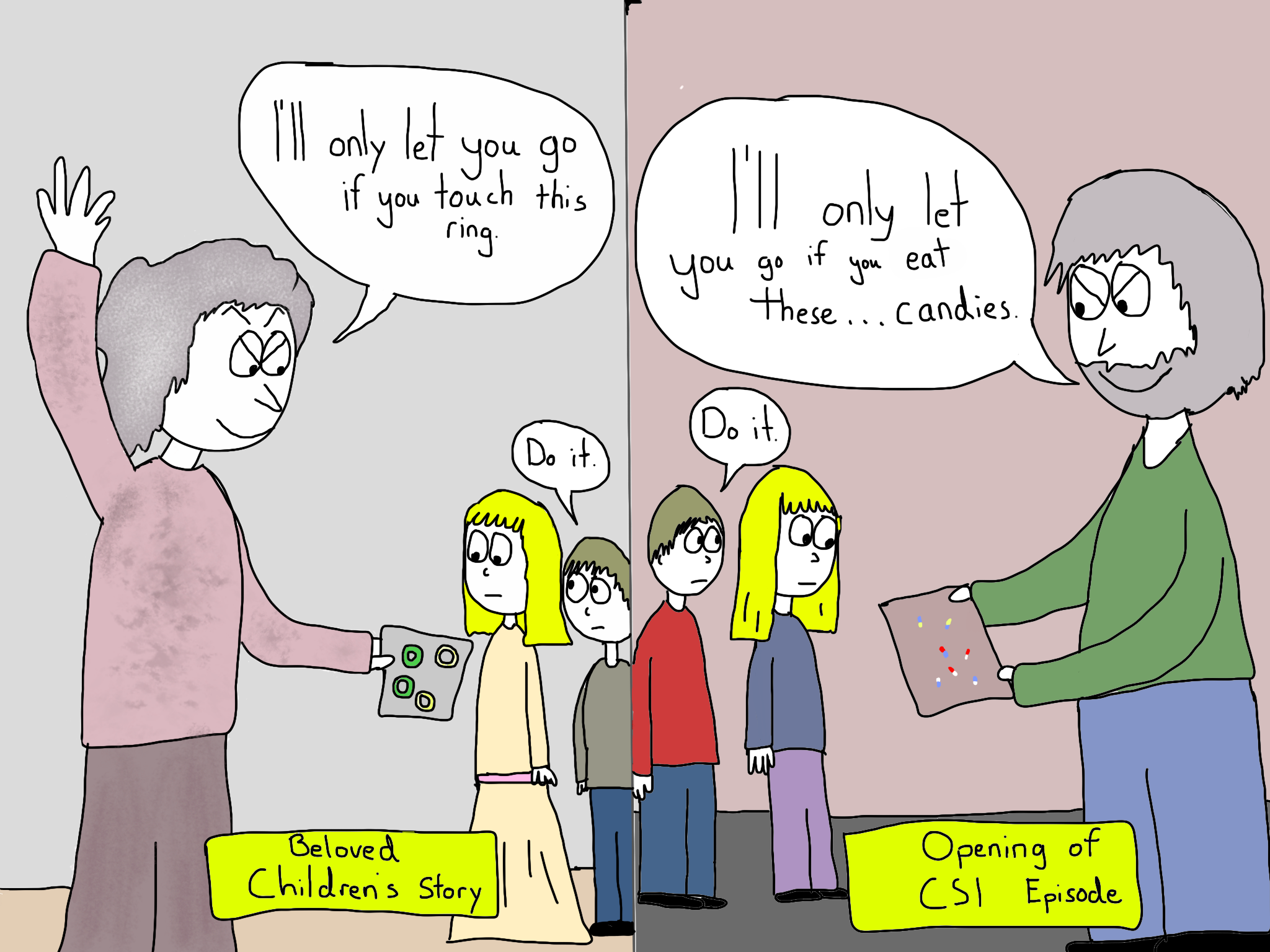
He says he needed two children for an experiment, but both Digory and Polly object. And now I’m starting to worry. And then he locks the door and won’t let the kids leave, and I check the cover of the book to make sure I’m reading a children’s story and not True Detective: Say Uncle. Funny how children stories and brutal crime stories have such similarities.
Finally, Uncle Andrew agrees to let Polly go, since it’s dinner time, and offers her a golden ring as a present. But when Polly touches the ring, she vanishes!
Prediction
POLLY: I’ve found something up there.
DIGORY: Where?
POLLY: If you go up the stairs and then up to the top, and then pass above the top-most room, and then reach the upper-front of the upstairs back beam, and then go through the sub-attic and into the upper attic doorway, which is actually a window, and then climb the anti-basement steps to the Alpha Attic, and then ride the escalator to the top of the chimney-space, you can get to the reverse-ceiling of the semi-roof!
For blogging updates, follow me on Twitter, Instagram and Facebook!
I make a sell magic pencils! This blog is brought to you by PowerPencils.com!