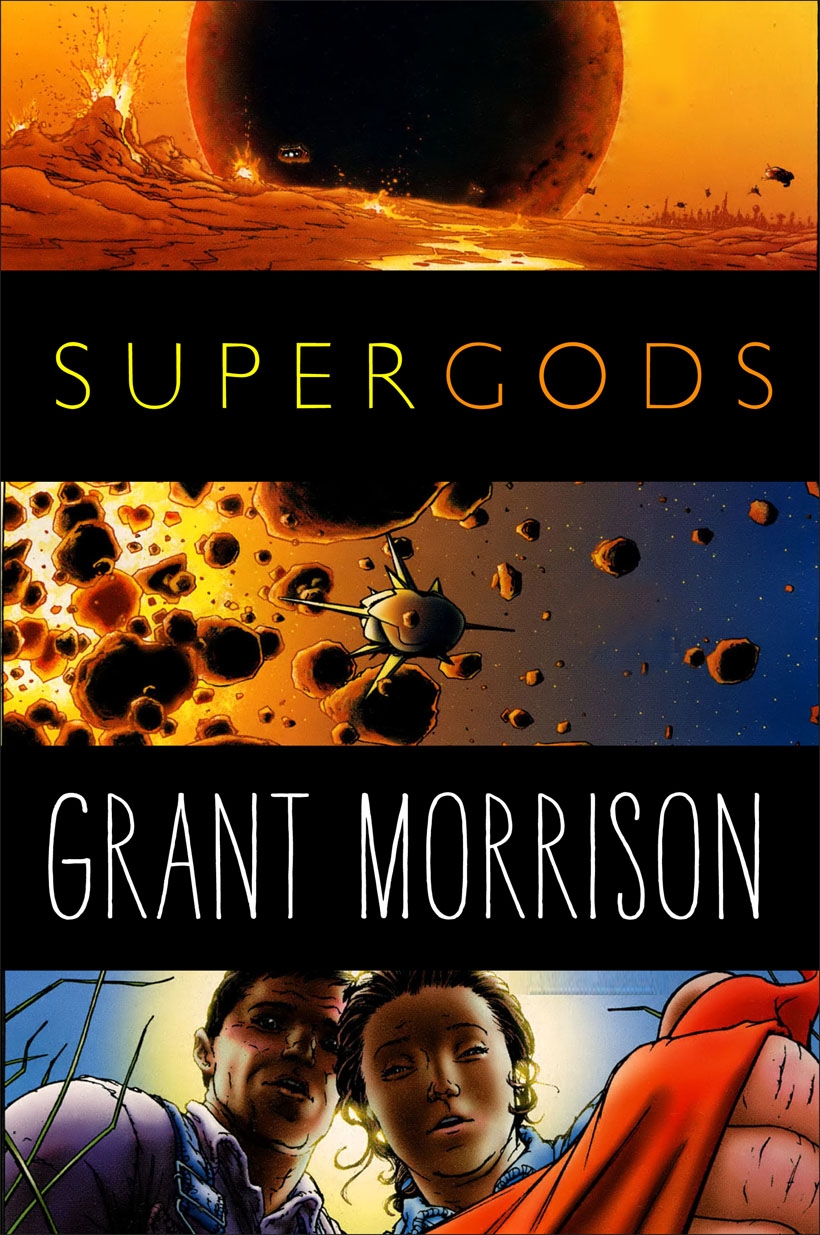
If you read only eighteen books about narrative structure and the history of comic books and culture, then Supergods: What Masked Vigilantes, Miraculous Mutants, and a Sun God from Smallville Can Teach Us About Being Human, by Grant Morrison should be one of them. It’s the best non-fiction book I’ve read in a long time and I loved every word.
I shy away from non-fiction most of the time. I don’t trust it. Biographies and autobiographies are rife with exaggeration and flat-out lies. Books about the economy, self-improvement, society, cows, etc. are all biased, and filled with hyperbole and more lies. And generally speaking, non-fiction books are bloated with fluffy chapters that are there only to make the book seem more booky.
I prefer my non-fiction in magazine form. Having worked in the magazine business, I know that even glossy pop culture rags must go through a fact-checking process (unless it’s a tabloid), and magazine articles must conform to size restrictions, which means so long to all the fluff.
But Grant Morrison’s book was something that rose above my distaste for non-fiction. First, it’s written by one of the most respected comic book writers, so he knows what he’s talking about. Morrison certainly deserves his seat at the genius table alongside Alan Moore, Neil Gaiman, and Frank Miller. He’s well known for his stories that play with the concept of comic books. If he’s famous for anything, it’s for an issue of Animal Man in which the hero looked over his shoulder, directly into the reader’s eyes, and said, “I can see you!”

Trippy, right?
Morrison is also crazy. He practices magic (not the Harry Potter stuff), admits to dabbling in psychotropic drugs, met the ghost of John Lennon, and wrote himself into his own fiction.
His abstract mind, coupled with a kinetic writing style, made this book a wild ride, something I rarely experience when reading non-fiction.
So what’s the book about?
Morrison runs through the history of comic books, from the first appearance of Superman to this summer’s blockbuster superhero movies. He explains the impact comic books had on culture, and vice versa. He explores the relationship between superheroes and the divine. And he details his own rise to fame, from a kid in a punk band to one of the highest paid writers of any medium.
Morrison is cocky, but he’s talking about his own industry of which he is a master, so if he doesn’t have a right to sound cocky, who does? The hyperbole and bias that I dislike in other non-fiction books, I loved here. I think it has to do with the author and his hyper, brainy writing style.
Speaking of bias, he’s clearly wearing a Team DC shirt. He writes about both major comic publishers, DC and Marvel, but whereas Batman and the Flash are discussed at length, the X-Men and Spider-Man are given only a few paragraphs.
And even some DC characters and writers are neglected. His discussion of the 80’s and 90’s is fascinating, though he glosses over Neil Gaiman too swiftly for my taste and Garth Ennis is mentioned only once. That’s a crime.
But these choices don’t deter from a fascinating account of the superhero world. Towards the end of the book, Morrison goes off on a few tangents, including a chapter-length account of an out-of-body experience he had in Africa, an experience wherein he rose above our three dimensional world and conferred with higher beings – an experience he denies was the result of drugs.
Trippy stuff, right?
If such tangents are not your cup of tea, you won’t like the book. But I found his asides and psychedelic insight entertaining and intriguing. I don’t believe for a minute that he actually met ancient aliens and transcended time, and I’d bet all my fingers that his “enlightenment” was the result of heavy drug use, but I still loved these tangents.
What I enjoyed most were Morrison’s ideas regarding storytelling. He believes stories are an infinite reality beneath our own, that Huck Finn and Captain Ahab are as real as raisins. He also imagines our world as a fiction for higher lifeforms.
Trippy stuff, right?
I’m not sure I buy into all, or any, of his ficto-science chatter. But it’s damn fun to read and think about. Weeks after finishing the book, I still find myself dreaming about his ideas.
Read this book. Read it hard!